

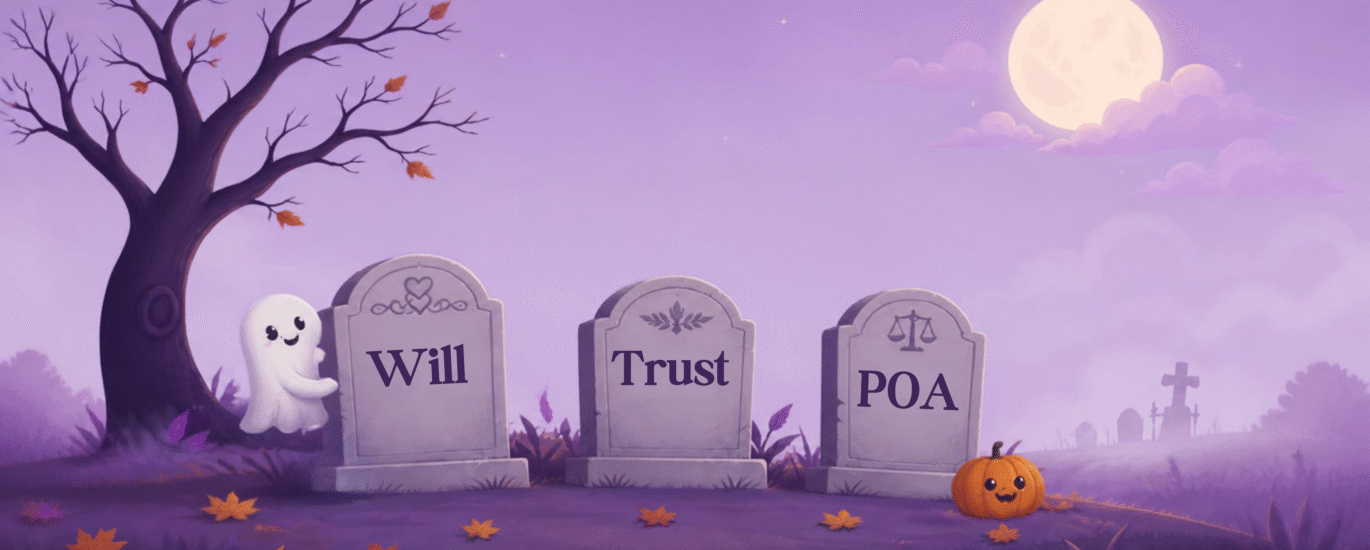
October is the season for haunted houses, scary movies, and things designed to give us a little fright.
Your estate plan should not be one of them.
Some of the biggest estate planning problems do not come from complicated legal issues. Instead, they often happen because someone never completed a plan, failed to update an old one, or assumed everything would simply work itself out.
Here are five estate planning mistakes that can create real problems for you and your family.
1. Dying Without a Will
If you die without a valid will, state law may determine who receives certain assets from your estate.
That result may match what you would have wanted. However, it may also be very different.
A will allows you to state who should receive your property and name the person you want to handle your estate.
For parents of minor children, a will can also nominate the person you would want to serve as guardian.
Without a will, your family may have to rely on state law and the court process to resolve decisions you could have made yourself.
2. Becoming Incapacitated Without a Power of Attorney
Estate planning is not only about what happens after death.
It should also prepare for the possibility that illness, injury, or another condition could leave you unable to manage your own affairs.
If that happens, someone may need authority to:
- Pay bills
- Access bank accounts
- Handle insurance matters
- Manage investments
- Deal with taxes
- Address real estate matters
- Communicate with financial institutions
A properly prepared power of attorney allows you to choose who should handle those matters.
Without one, your family may have fewer options. As a result, they may eventually need court involvement to obtain legal authority to act for you.
3. Creating a Trust but Never Funding It
Signing a trust does not always complete the planning process.
Depending on the type of trust and why you created it, you may also need to transfer certain assets into the trust.
This process is often called funding the trust.
For example, you may need to change the title to real estate or coordinate financial accounts with the trust.
If the assets that were supposed to go into the trust remain outside of it, the trust may not work the way you expected.
For that reason, it is important to review both the trust document and the way your assets are titled.
4. Letting an Old Estate Plan Sit Untouched for Years
An estate plan that worked ten years ago may no longer fit your life today.
Families change. Finances change. Relationships change.
Over time, your documents may still name:
- A former spouse
- Someone who has died
- A person you no longer trust
- An executor who can no longer serve
- A health care agent who has moved away or is no longer available
Your beneficiary designations may also be outdated, even if you already updated your will.
Because of that, major life changes should be a reminder to review your estate plan.
Those changes may include marriage, divorce, the birth of a child, the death of a loved one, retirement, a move to another state, or a significant change in your finances or health.
5. Assuming Your Family Will “Figure It Out”
Many people believe their family already knows what they want.
That may be true.
Still, knowing what you want and having the legal authority to carry it out are two different things.
Without clear documents, families may face difficult questions during an already stressful time.
For example:
Who should make health care decisions?
Who should manage your finances?
Which person should handle your estate?
Who should receive certain property?
Did you intend for someone to keep the money in a joint account?
What should happen to your home?
Even close families can disagree. Therefore, clear estate planning documents can help reduce confusion and give the people you trust guidance to follow.
Estate Planning Does Not Have to Be Scary
Creating an estate plan does not mean you need to predict every possible event.
Instead, a good plan gives your family a clear framework for the situations that matter most.
For example, your plan can help address:
- Incapacity
- Health care decisions
- Financial management
- The transfer of property after death
- The people you trust to act on your behalf
The goal is not to prepare for every worst-case scenario.
Rather, it is to make sure the people you trust know what to do if they ever need to step in.
When Was the Last Time You Reviewed Your Estate Plan?
If you have never created an estate plan, October may be a good time to finally move it off your to-do list.
If you already have one, consider when you last reviewed it.
You may not need to change anything. However, reviewing your documents can help confirm that your plan still matches your current family, finances, property, and wishes.
Ready to Take the Fright Out of Estate Planning?
Monteleon Law, PLLC assists individuals and families in New York and Virginia with estate planning, trusts, wills, powers of attorney, health care planning, probate, estate administration, and related elder law matters.
Contact Monteleon Law today to schedule a consultation and take the next step in protecting your future.
For more information about estate planning and elder law, visit our Resources page for additional articles, newsletters, and educational resources.
This article is for educational purposes only and is not intended to provide legal advice. Laws and requirements vary by state and individual circumstances. Consult with a qualified attorney regarding your specific situation.